Written for the reader
Plain-language guidance for patients, clinical decision support for doctors, a jurisdiction view for agencies, from the same census-tract forecast.
Health Atlas · in development · for patients, clinicians and public health agencies
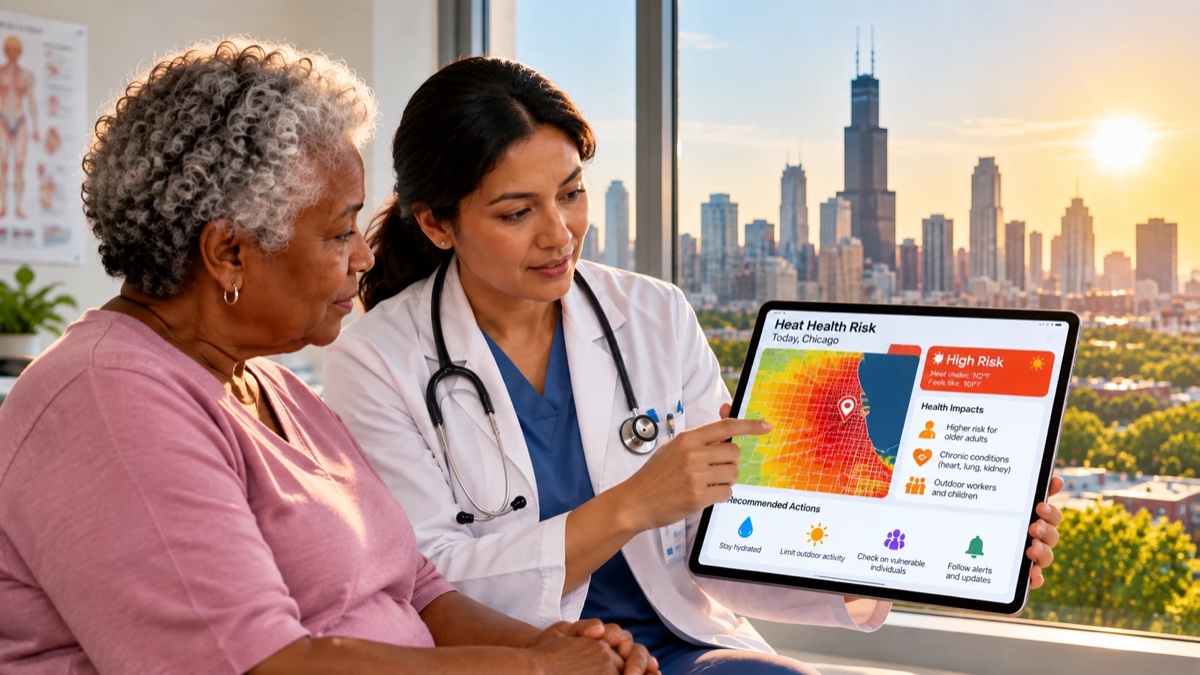
Health Atlas turns environmental forecast into a public risk tier and the cited actions it calls for, written for a patient, a clinician, or a health department. The local climate record and projections sit alongside. Extreme heat is the first driver.
The problem
Environmental advisories reach everyone in the same words. A patient, a physician and a health department each need a different next step.
Good environmental health guidance already exists from the CDC, the National Weather Service, state health departments and state emergency management agencies. It is spread across advisories, fact sheets and clinical pages, and none of it is keyed to what the forecast says for one place this week.
Business value
Plain-language guidance for patients, clinical decision support for doctors, a jurisdiction view for agencies, from the same census-tract forecast.
Each action starts at a named tier of a public scale (for heat, the NWS heat-index categories), so a Danger day brings different steps than a Caution day.
Every action carries its references: the CDC, NWS, state health and emergency management agencies, and peer-reviewed work. Nothing is the model’s own clinical advice.
How it works
The same pipeline as every Tempra product: data, metric, tier, role-specific action, evidence. The climate record runs alongside as context, never mixed with the forecast.
Hourly, six days ahead, census tract by census tract, from a Tempra Labs proprietary forecast model.
Temperature and humidity combined into the heat index the NWS uses for advisories.
Caution, Extreme Caution, Danger or Extreme Danger, using the NWS categories.
For each tier: self-care steps for patients, clinical steps for doctors, plan and outreach steps for agencies.
Each action lists its sources: the CDC, NWS, a state health or emergency management agency, or a peer-reviewed paper.
Extreme-heat days by decade since 1951 and projected summer warming by scenario to 2100, from public NOAA and USGS records.
Where each role fits
Plain-language guidance for the tier where you live, and a chat that explains it without diagnosing or changing medications.
The census-tract forecast, its NWS tier and the cited clinician actions embedded in the assistant’s context for a patient visit.
Census tracts and counties in the jurisdiction ranked by forecast tier, with the agency actions each tier calls for.
The same view rolled up from census tract to county, health region and state, for planning and outreach.
Health Atlas is decision support, not a medical device. It does not replace clinical judgment or official NWS and state health department alerts. The assistant is an open-weights model run by Tempra Labs, and its output is labeled as model reasoning, not a statistical result. The product’s health-outcome analyses are pre-registered and reported with their limitations. Demo data are fictional and labeled as synthetic.